Example: Continuous stirred tank reactor#
This section shows the implementation of a control of a continuous stirred tank reactor with GRAMPC-S, which can be found in the folder examples/reactor. A simplified and normalized version of the model from [1], [2] is used, which is [3]
where \(c_A\) is the normalized concentration of the educt \(A\), \(c_B\) is the normalized concentration of product \(B\), \(u\) is the volume flow rate, and
are parameters of the process. The optimization problem
should be solved, where the system dynamics are given by (2) and \(\Delta \vm x = \vm x - \vm x_\text{des}\) and \(\Delta u = u - u_\text{des}\) denote the deviation of the states and the control input from the corresponding desired values, with the weight matrix \(\vm Q = \mathrm{diag}([10^2, 10^2])\).
It is assumed that the current state is not exactly known due to measurement noise, which makes it necessary to predict the uncertainties.
These are required to evaluate the probabilistic constraint for the concentration \(c_B\).
The problem description will now be implemented for this OCP.
For this purpose, a class ReactorProblemDescription is created, which provides all the necessary functions from Section Implementation of the problem description.
First, the constructor is implemented:
ReactorProblemDescription::ReactorProblemDescription(const std::vector<typeRNum>& pSys,
                                                    const std::vector<typeRNum>& pCost,
                                                    const std::vector<typeRNum>& pCon)
 : ProblemDescription(2, 1, 0, 0, 1, 0, 0),
   pSys_(pSys), pCost_(pCost), pCon_(pCon)
{}
The constructor receives vectors containing the system parameters, the coefficients for the cost function and for the constraint and saves them in member variables.
In the initializer list the number of states, control inputs, parameters, and constraints is passed to the base class ProblemDescription.
The system dynamics in (2) are implemented in the function ffct:
void ReactorProblemDescription::ffct(VectorRef out, ctypeRNum t,  VectorConstRef x, VectorConstRef u, VectorConstRef p, const GrampcParam& param)
{
    out[0] = -pSys_[0] * x[0] - pSys_[2] * x[0] * x[0] + (1 - x[0]) * u[0];
    out[1] = pSys_[0] * x[0] - pSys_[1] * x[1] - x[1] * u[0];
}
Here, the member variable pSys_ is used, which was set in the constructor.
Next, the cost function must be implemented in the function lfct:
void ReactorProblemDescription::lfct(VectorRef out, ctypeRNum t, VectorConstRef x,  VectorConstRef u, VectorConstRef p, const GrampcParam& param)
{
    auto& xdes = param.xdes;
    auto& udes = param.udes;
    out[0] = pCost_[2] * (x[0] - xdes[0]) * (x[0] - xdes[0]) +
    pCost_[3] * (x[1] - xdes[1]) * (x[1] - xdes[1]) +
    pCost_[4] * (u[0] - udes[0]) * (u[0] - udes[0]);
}
Again, a member variable is accessed, which was set in the constructor.
If terminal constraints need to be taken into account in addition to the iterative costs, these must be implemented in the function Vfct.
The inequality constraint is implemented in the function hfct:
void ReactorProblemDescription::hfct(VectorRef out, ctypeRNum t, VectorConstRef x,  VectorConstRef u, VectorConstRef p, const GrampcParam& param)
{
    out[0] = x[1] - pCon_[0];
}
The underlying solver GRAMPC is gradient-based, so some derivatives with respect to \(\vm x\) and \(u\) must be implemented for the above functions. As described in Section Implementation of the problem description, the matrix product of the Jacobian matrix and an arbitrary vector, which is passed as a pointer, is returned for the derivatives of the system dynamics and the constraint:
void ReactorProblemDescription::dfdx_vec(VectorRef out, ctypeRNum t,  VectorConstRef x, VectorConstRef u, VectorConstRef p, VectorConstRef adj, const GrampcParam& param)
{
    out[0] = (-pSys_[0] - pSys_[2] * 2 * x[0] - u[0]) * adj[0] + pSys_[0] * adj[1];
    out[1] = (-pSys_[1] - u[0]) * adj[1];
}

void ReactorProblemDescription::dfdu_vec(VectorRef out, ctypeRNum t,  VectorConstRef x, VectorConstRef u, VectorConstRef p, VectorConstRef adj, const GrampcParam& param)
{
    out[0] = (1 - x[0]) * adj[0] + (-x[1]) * adj[1];
}

void ReactorProblemDescription::dldx(VectorRef out, ctypeRNum t, VectorConstRef x,  VectorConstRef u, VectorConstRef p, const GrampcParam& param)
{
    auto& xdes = param.xdes
    out[0] = 2 * pCost_[2] * (x[0] - xdes[0]);
    out[1] = 2 * pCost_[3] * (x[1] - xdes[1]);
}

void ReactorProblemDescription::dldu(VectorRef out, ctypeRNum t, VectorConstRef x,  VectorConstRef u, VectorConstRef p, const GrampcParam& param)
{
    auto& udes = param.udes;
    out[0] = 2 * pCost_[4] * (u[0] - udes[0]);
}

void ReactorProblemDescription::dhdx_vec(VectorRef out, ctypeRNum t,  VectorConstRef x, VectorConstRef u, VectorConstRef p, VectorConstRef vec, const GrampcParam& param)
{
    out[0] = 0.0;
    out[1] = vec[0];
}

void ReactorProblemDescription::dhdu_vec(VectorRef out, ctypeRNum t,  VectorConstRef x, VectorConstRef u, VectorConstRef p, VectorConstRef vec, const GrampcParam& param)
{
    out[0] = 0.0;
}
All functions of the OCP are now defined.
The next step is to define the distribution of states, create and parameterize the solver and implement the MPC loop.
This is realized in the function main, which is located in the file reactor_simulation_main.cpp for this example.
First, the initial state \(\vm x_0\) is created as a Gaussian distribution with mean \(\mathbb{E}[\vm x_0] = [0.7,\, 0.01]\trans\) and covariance matrix \(P = 10^{-5} \; \vm I\):
Vector x0(2);
Matrix P0(2,2);
x0 << 0.7, 0.01;
P0 << 1e-5, 0, 0, 1e-5;
DistributionPtr state = Gaussian(x0, P0);
In principle, all methods from Section Approximation of the stochastic OCP can be used to propagate the uncertainties. In this example we use polynomial chaos expansion with a maximum polynomial order of 2 and solve the occurring integrals using Gaussian quadrature with a grid of 3 points per dimension:
PointTransformationPtr transform = PCE(2, 2, state->polynomialFamily(), 2, 3);
Next, the approximation of the probabilistic constraint is determined by the Chebyshev inequality:
Vector vec_chance_constraint(1);
vec_chance_constraint << 0.95;
ChanceConstraintApproximationPtr constraintApprox =  Chebyshev(vec_chance_constraint);
The class ReactorProblemDescription has already been implemented in the previous steps.
An object of this class is now created and passed to a SigmaPointProblemDescription:
ProblemDescriptionPtr reactorProblem = ProblemDescriptionPtr( new ReactorProblemDescription(pSys, pCost, pCon));
SigmaPointProblemDescriptionPtr problem = SigmaPointProblem( reactorProblem, constraintApprox, transform);
The SigmaPointProblemDescription represents the approximation of the stochastic OCP, which can be solved by GRAMPC.
To this end, a solver must be created and the pointer to the problem description must be passed to it:
GrampcPtr solver = Solver(problem);
Next, the solver must be parameterized, which is skipped here for reasons of space, but can be found in the file reactor_simulation_main.cpp.
Finally, the MPC loop is implemented.
In each time step, the solver is called, the system is simulated and the current state and time are passed to the solver:
for(typeRNum t = 0; t < Tsim; t += dt_MPC)
{
    solver->run();

    //  simulate system
    Eigen::Map<const Vector> uMap(solver->getSolution()->unext, u0.size());
    x0 = sim.simulate(uMap);
    state->setMeanAndCovariance(x0, P0);

    // set current state and time
    problem->compute_x0_and_p0(state);
    solver->setparam_real_vector("x0", problem->x0());
    solver->setparam_real("t0", t);
}
Fig. 2 shows the results of the simulation for desired states \(\vm x_\text{des} = [0.215, \,0.09]\trans\) and a desired control input \(u_\text{des} = 19.6\). First, the concentration \(c_A\) decreases and the concentration \(c_B\) increases until the constraint becomes active. The deviation between the trajectory of \(c_B\) and the value of 0.14 results from the constraint tightening with the Chebyshev inequality due to the state uncertainty.
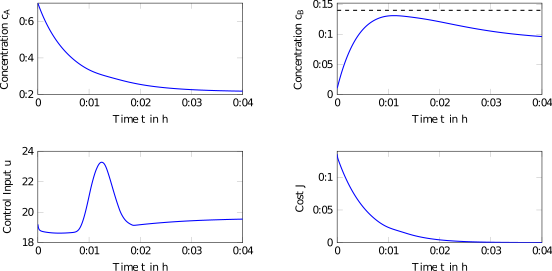
Fig. 2 Results of the stochastic MPC simulation for the chemical reactor.#